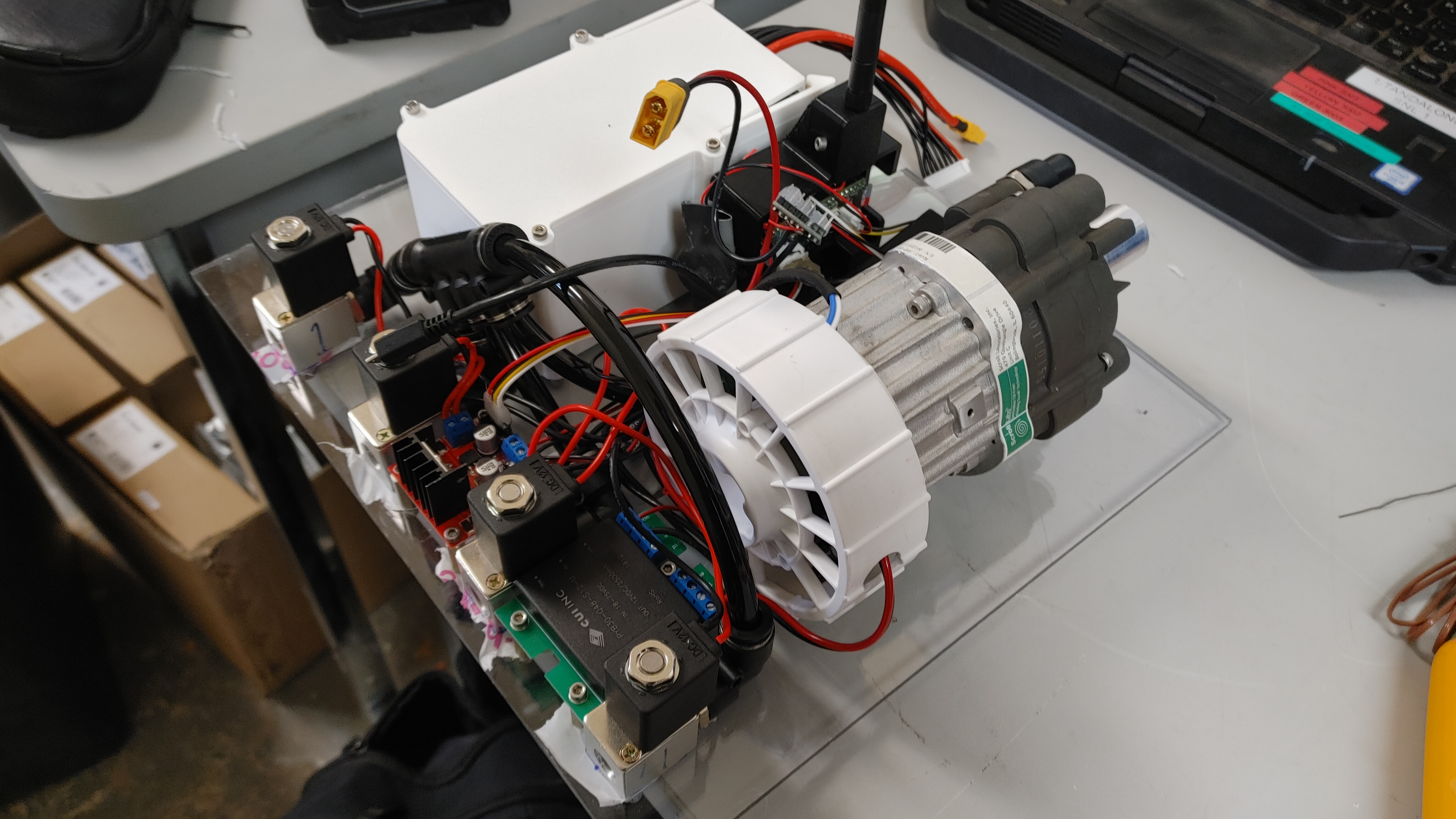
PUFIN INP Collector
Date: 2024-11 | Duration: 16 weeks | Status: complete_in_use | Budget: $7500Goal
Design and build a lightweight airborne instrument capable of collecting vertically resolved atmospheric aerosol samples for ice nucleating particle (INP) analysis using tethered balloon systems.
Requirements
Collect aerosol samples at multiple altitudes during a single tethered balloon flight.
Operate reliably in harsh environmental conditions including low temperature, low pressure, and high UV exposure.
Remotely monitor system status and sensor data from the ground during flight.
Maintain a lightweight payload (<7 kg) compatible with ARM Tethered Balloon System payload limits.
Provide controlled airflow through multiple filters with accurate flow measurement.
Support sample collection sufficient for detecting INP concentrations as low as ~10^-3 L^-1.
Operate on battery power for at least 3 hours to match typical balloon flight durations.
Integrate with ARM instrumentation and operational procedures.
Result / Current Incarnation
Article Documenting Instrument
PUFIN (Profiling Upper altitudes For Ice Nucleation) successfully demonstrated routine airborne sampling of atmospheric ice nucleating particles across multiple altitude layers during tethered balloon flights.
The system collects up to three aerosol samples plus a field blank during a single flight, enabling vertically resolved measurements of INP concentrations.
Deployments during Atmospheric Radiation Measurement (ARM) campaigns in Maryland and Alabama demonstrated reliable operation and the ability to detect INPs down to approximately 10^-3 L^-1 within sampling periods of roughly 30–60 minutes.
The instrument improved substantially over the previous "IcePuck" system by increasing airflow and sample volume, allowing shorter sampling times and more altitude measurements per flight.
Data collected with PUFIN are now publicly available through the ARM Data Center and are being used to study vertical variability in aerosol-cloud interactions.
Specifications
Weight (flight-ready): ~6.1 kg
Power system: 28.8 V 14 Ah lithium battery pack (8S4P configuration)
Battery life: ~3.5 hours depending on flow rate and environmental conditions
Pump: ScrollLabs SVF-E0-50P dry scroll pump
Maximum airflow: ~11 standard liters per minute with filter installed
Flow sensor: Sensirion SFM4300 (0–50 sL/min range)
Sampling filters: 47 mm 0.2 μm polycarbonate membrane filters
Filter capacity: 3 sampling filters + 1 field blank per flight
Valves: 4 stainless steel solenoid valves (individually controlled)
Control system: Teensy 4.1 microcontroller with analog pump control via DAC
Communications: NRF24L01 2.4 GHz RF transceiver with 9 dBi antenna
Sensors: iMet-XQ2 atmospheric sensor (pressure, temperature, humidity, GPS)
Data logging: onboard SD card plus real-time telemetry to ground station
Enclosure: UV-resistant ASA 3D-printed housing with integrated cooling fan
Structural backing: aluminum ground distribution plate for mechanical mounting
Operating platform: DOE ARM tethered balloon system (TBS), typically flown up to ~1 km altitude