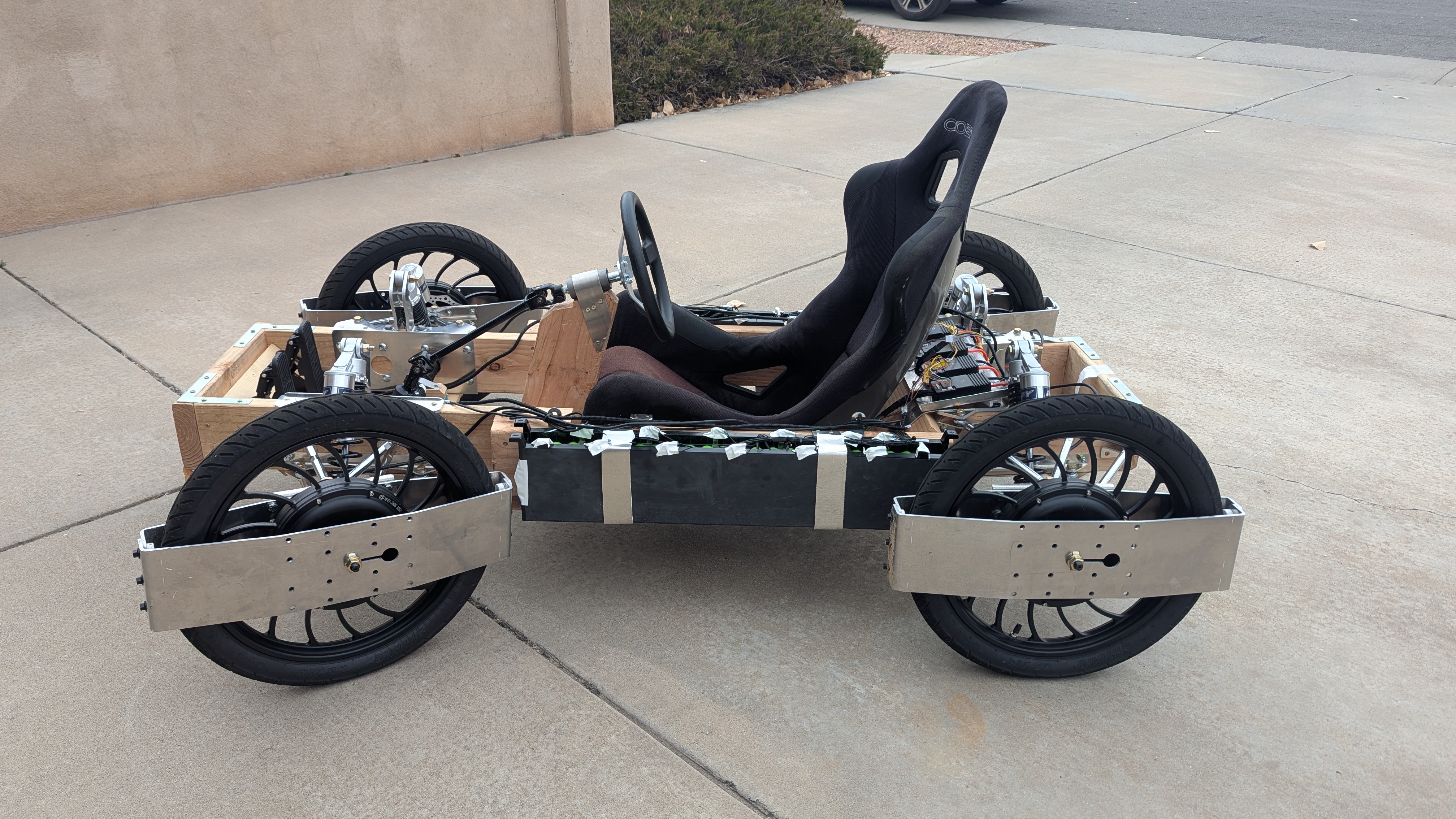
Quadwood Go-Kart
Date: 2025-7 | Duration: 8 weeks | Status: complete_in_storage | Budget: $3786Goal
Design and build a fun go-kart to study and implement 4-wheel-drive control algorithms.
Requirements
Four independant motors with controllers advanced enough for real-time traction-control, torque vectoring, and regenerative braking.
Result / Current Incarnation
The project is currently complete and in storage. After implementing traction control, torque vectoring, and live user configuration of driving behavior the project reached the bounds of its usefulness for the time being.
Specifications
Overview:
- Fully electric, four-wheel-drive vehicle
- Hubmotor based drivetrain with independent wheel control
- VESC-based motor control network with CANBus communication
- Custom battery system assembled from recycled cells
- Purpose-built chassis
- Fully independent suspension
Drivetrain:
- Four 48v three phase permanent magnet brushless DC hub motors (20 in e-bike conversion motors)
- Integrated hall-effect sensors for rotor position feedback
- Four Flipsky 75100 Pro V2.0 VESC-based motor controllers with canbus communication
- Field-oriented control (FOC) with per-wheel torque and speed control
- Controllers networked over CANBus for synchronized control and telemetry
- Foot-operated throttle pedal used as primary driver input
- DOT-rated Shinko SR 714 moped tires
Tractive battery:
- Battery system assembled from recycled modules
- Primary pack constructed from 2x 12s4p A123 26650 LiFePO cells
- Active-balancing BMS rated for up to 150 A continuous current
- BMS with serial, canbus, bluetooth, and wifi communication for cell monitoring and diagnostics
- XT-90s connectors used throughout for high-current connections
Chassis:
- Primary structure constructed from standard hardware-store dimensional lumber (2×6 boards)
- Fastened using common construction screws and steel corner brackets
- Layout and dimensions optimized around a single driver (myself) with no adjustability
- Chassis prioritizes ease of modification and rebuild over weight or aesthetics
- Cobra Suzka racing bucket seat mounted directly to wooden frame
Suspension:
- Fully independent suspension at all four corners
- Suspension arms fabricated from adjustable steel heim-joint tensioning rods
- Custom laser-cut and bent aluminum suspension mounting brackets
- Use of automotive-grade fasteners, washers, and nylon-insert locknuts throughout
- Rear suspension damped using 320 mm motorcycle/go-kart shock absorbers
- Suspension geometry adjustable via threaded rod ends for alignment and experimentation
Steering:
- Rack-and-pinion steering system adapted from a small go-kart steering kit
- Steel steering shaft with direct mechanical linkage (no assist)
- Magnetic steering angle sensor for control system input
Electrical and controls:
- CANBus used for inter-controller communication between VESCs and Teensy 4.1 control board
- Arduino-based control system planned for higher-level vehicle logic
- JST, XT90S, MT60, and Micro-Fit connectors used for modular wiring
Design philosophy:
- Built using readily available parts, surplus components, and online marketplace finds
- Design choices favor learning, iteration, and repairability over efficiency
- Intentionally “rough but functional” construction aesthetic
- Project serves as a rolling test platform rather than a finished product
Cost breakdown:
- Total project cost (parts used in final iteration): ~$3,786
- $1,820 (48%) Drivetrain and power
- $660 (17%) Battery and charging
- $1,430 (38%) Suspension and steering
- $230 (6%) Chassis and structure
- $190 (5%) Electrical and miscellaneous